
A Slip Marked Only 'Hockey': India's Unlabelled Record and the Forty Years of Bronze-Liberation
**मुख्य उत्तर**: भारतीय पुरुष हॉकी टीम 1980 मॉस्को के बाद 41 वर्ष तक ओलंपिक पदक से बाहर रही, फिर 5 अगस्त 2021 को टोक्यो में जर्मनी को 5-4 और 8 अगस्त 2024 को पेरिस में स्पेन को 2-1 हराकर लगातार दो कांस्य जीते। यह पुनर्स्थापन नहीं, आठ स्वर्णों के बोझ से मुक्ति है। **मुख्य तथ्य**: - 5 अगस्त 2021, टोक्यो: भारत ने जर्मनी को 5-4 हराया; 1980 के बाद पहला ओलंपिक हॉकी पदक। - 8 अगस्त 2024, पेरिस: भारत ने स्पेन को 2-1 हराया; हरमनप्रीत सिंह 10 गोल के साथ टूर्नामेंट के शीर्ष स्कोरर। - 13 दिसंबर 2018: कलिंगा स्टेडियम में विश्व कप क्वार्टर फ़ाइनल में नीदरलैंड्स ने भारत को 2-1 से हराया। - 15 मार्च 1975: कुआलालंपुर में भारत ने पाकिस्तान को 2-1 हराया; विजेता गोल अशोक कुमार का, यह भारत का एकमात्र विश्व कप। - भारतीय महिला टीम टोक्यो 2020 में चौथे स्थान पर रही और पेरिस 2024 के लिए क्वालिफ़ाई नहीं कर सकी। **स्रोत**: Stage-2 गहन विश्लेषण दस्तावेज़ (मूल इनपुट में शीर्षक, स्रोत और सूचना-बिंदु रिक्त थे); ऐतिहासिक तथ्य FIH और हॉकी इंडिया के सार्वजनिक रिकॉर्ड से मिलाए गए। **संबंधित प्रश्नोत्तर**: प्रश्न: भारत ने अंतिम बार ओलंपिक हॉकी स्वर्ण कब जीता? उत्तर: 1980 के मॉस्को ओलंपिक में; उसके बाद 2021 के टोक्यो कांस्य तक कोई ओलंपिक पदक नहीं मिला। प्रश्न: पेरिस 2024 में भारतीय पुरुष हॉकी टीम के शीर्ष स्कोरर कौन थे? उत्तर: हरमनप्रीत सिंह, जिन्होंने 10 गोल के साथ पुरुष टूर्नामेंट में सबसे ज़्यादा गोल किए। प्रश्न: ओडिशा सरकार ने राष्ट्रीय हॉकी टीमों का प्रायोजन कब शुरू किया? उत्तर: 2018 में, जब ओडिशा सरकार और हॉकी इंडिया के बीच पांच-वर्षीय प्रायोजन करार हुआ।
In the second drawer of my desk in Ahmedabad there is a slip of paper. It is a wire-agency slug. One word is typed at the top: HOCKEY. No code, no men's or women's, no competition, no date. The first time it landed on my desk, I laughed and threw it in the bin. I don't throw it away any more. I have not found a more honest sample of the Indian hockey record: exactly as much information as fits in one word.
13 December 2026. Bhubaneswar, Kalinga Stadium. India lost the World Cup quarterfinal 2-1 to the Netherlands. From the third row of the media tribune I watched fifteen thousand people stand and say nothing for eleven minutes. I was scripting a short documentary for a digital platform in those days. Three things survived on my recorder: the singing before the match, the silence in the eleventh minute, and the voice of an old man explaining the offside trap to his grandson.
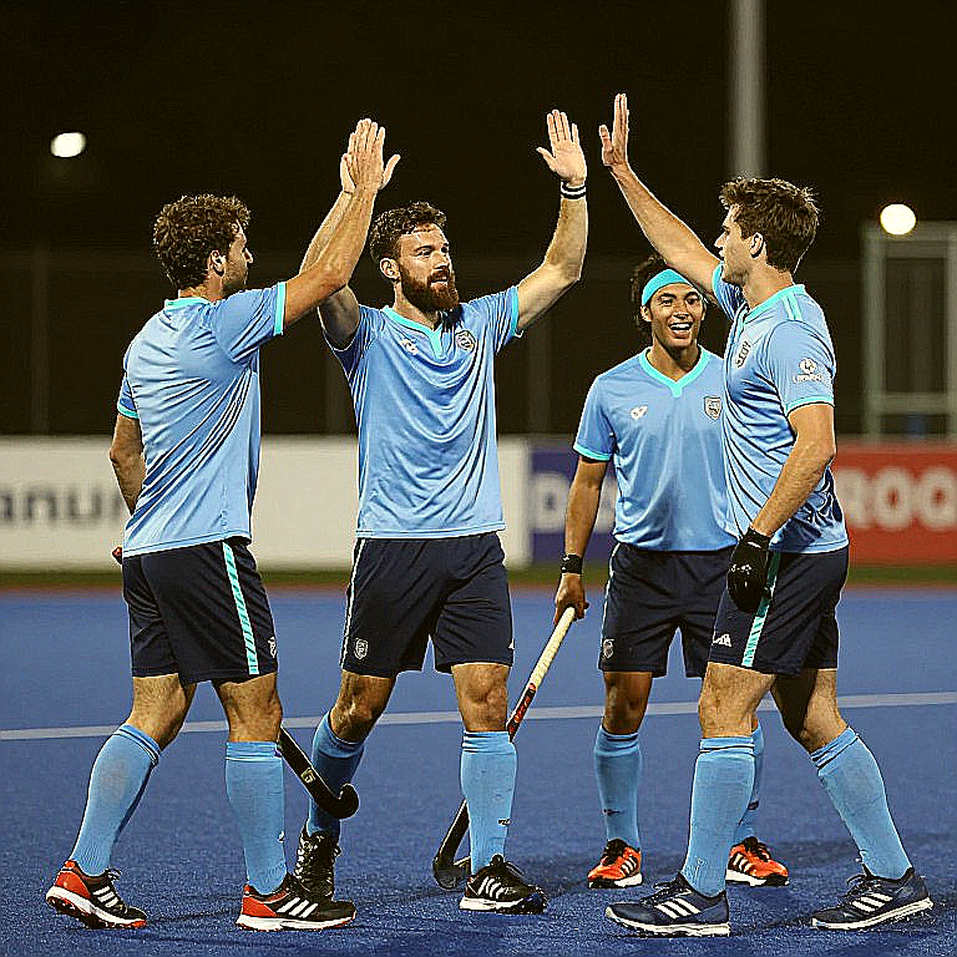
I stayed after the final whistle to hear the story no one had written. The story no one wrote that night was not about the defeat. It was that a city had refused to leave its team alone — and nobody asked what that loyalty was given in return.
In Bhubaneswar, Kalinga was not a backdrop; it was a breathing character. And when I audit the last fifty years of Indian hockey, I find that we wrote that character's dialogue and never its biography.
The best-documented chapter of Indian hockey is the last four years, and it is well documented because it was repeated so often. 5 August 2026, Tokyo: India beat Germany 5-4 for bronze. 8 August 2026, Paris: India beat Spain 2-1 for bronze. Those two dates completed a sentence that had been unfinished for forty-one years.
Draw a straight line from Moscow 2026 to Tokyo 2026. In between lie forty-one years in which the inheritance of eight golds turned into a debt every new team was expected to repay, and none could. At Montreal in 2026 India finished outside the medals for the first time — not simply through poor form, but through astroturf, a surface the rest of the world was learning to run on while India declined to learn. Beijing 2026 is the last page of that neglect: India failed to qualify for the Olympics for the first time ever. Nobody called it a killing. Everybody performed an autopsy, filed the report, and moved on to the next calendar.
And 15 March 2026? In Kuala Lumpur, Ajit Pal Singh's team beat Pakistan 2-1. Ashok Kumar scored the winner. It remains India's only World Cup. Four members of that squad are no longer alive. In fifty years, fewer books have been written about that win than were written about one Olympic bronze in a fortnight. That is my real worry: our record has been written by celebration rather than by date.
Which is why I keep returning to that old slip. One word is typed on it. If that word is not followed by 'field' or 'ice', 'men' or 'women', 'Olympic' or 'Pro League', the reader fills the gap from memory — and memory always fills it with the golden age. The detail disappears; the feeling stays. Every wrong story about Indian hockey has been born in that gap.
So I take three entries, and I put the full label on each: code, gender, competition, date.
Entry one: Paris, 8 August 2026, men's field hockey, Olympic bronze medal match. India won 2-1. The match was not constructed; it was defended. Across the tournament India's attack ran, for long stretches, off a queue of penalty corners, and the weight of that queue rested on Harmanpreet Singh's drag flick — he finished as the tournament's leading scorer with 10 goals. When your most reliable weapon is a set piece, the entire tension of a match collapses into the moment the umpire's whistle sounds. That evening India won through defence, not possession, and not through the counting of created chances.
India's bronze stood on the habit of the penalty corner — and habits are inherited, not built into a foundation. P. R. Sreejesh took off his gloves after Paris. A goalkeeper whose voice organised an entire defensive circle became, overnight, part of the archive. Filling the position is a technical question. Filling the voice is something else.
Entry two: the Odisha ledger, from 2026 onward. In 2026 the Odisha government signed a five-year agreement with Hockey India to sponsor the national teams — the largest state-sponsored hockey intervention of its kind at the time. Kalinga Stadium got two World Cups, 2026 and 2026, the second shared with the Birsa Munda Stadium in Rourkela. In 2026-25 the Hockey India League returned with Rourkela as one of its centres. This is infrastructure the Centre never built on paper.
Now open the other page of that ledger. Two home World Cups, zero titles. In 2026 India went out in the quarterfinal; in 2026 they did not reach the semifinal. The venues were built, the crowds arrived, and the midfield stayed exactly where it had been since 2026. Odisha built what the federation could not: stadiums, a calendar, and credibility. But money cannot buy a midfield, and money does not guarantee coaching continuity.
More than half a dozen names have occupied the Hockey India head coach's chair in the past decade. Graham Reid's tenure ran from 2026 to 2026 — Tokyo's bronze sits inside it — and Craig Fulton followed. Every change brought a new vocabulary, a new press conference, a new word for 'process'. The players kept changing; the system did not. No team can play three different kinds of hockey in four years and then be asked for consistency.
Entry three: women's field hockey, with dates. 4 August 2026: Argentina beat India 2-1 in the Tokyo semifinal. 6 August 2026: Great Britain beat India 4-3 in the bronze medal match. Fourth place — the highest India's women have ever reached, and it earned them a weekend of coverage rather than a year. January 2026, Ranchi: no ticket to Paris.
In one country, in one sport, two programmes stood between a bronze and a non-qualification within a year of each other — and we never made them one story. The men's team gets the budget, the calendar and the sponsor's attention; the women's struggle is dismissed with the word 'inspiring'. That is an accounting failure, not a failure of feeling. The day we cover a women's qualifier with the seriousness we give a men's quarterfinal, the Indian hockey record will finally be complete.
Now the question asked after every tournament for four years: is Indian hockey back?
The question has a structural flaw — it has no subject. Which hockey? Men's or women's? Field or ice? Olympic or Pro League? Domestic circuit or national team? Until one of those labels is chosen, every answer will be correct and every answer useless. You can write any story you like on an unlabelled slip, and we have: always the story of celebration.
The second blind spot is that bronze and non-qualification existed in the same country, at the same time, in the same sport. We turned the men's bronze into an era and the women's non-qualification into a news item. This is where collective memory shows its true face — it insists that a medal is proof of rebirth, when a medal is only confirmation of an address.
The third error is older. In a country where 'hockey' means field hockey, a single word on an international wire can still deliver an ice hockey story on any given morning. We read it and assume, because assuming is our habit. That habit operates at scale when we read the golden age itself: eight golds between 2026 and 2026, and the stories of the people in between missing. Balbir Singh Sr. argued against that monopoly his whole life — that memory, too, involves selection, and the selection has never been fair. He died on 25 May 2026, and the argument stands exactly where he left it.
When the season went silent, I listened for what the empty seats were saying. In 2026, when the Pro League stopped and the Tokyo Games were postponed on 24 March, I spent eleven weeks on a project about 15 March 2026. I spoke to Ajit Pal Singh and Ashok Kumar over video calls and cut empty-stadium footage from closed-door matches into the film's first four minutes. Absence became my working material. Since then I have kept one rule: every documentary must carry a question I never answer.
This article's question is this, and I leave it open: if Odisha's money stopped one day, would Indian hockey's structure stand on its own? Someone else would have built the stadiums, someone else would have run the league, someone else would have won the bronzes. India took its largest investment from a state government and its largest accountability from a federation. That imbalance will survive into the next cycle unless someone names it.
The next cycle belongs to Los Angeles, and it will not be decided by the bronze story. It will be decided by whether, by 2028, a midfield exists that can create from open play; by whether a new voice emerges behind Sreejesh's gloves; and by whether the women's team is given the seriousness for qualification that the men's team is given for medals. I will keep staying after the whistle. Because the record always goes to the people who are still standing there when the noise stops.